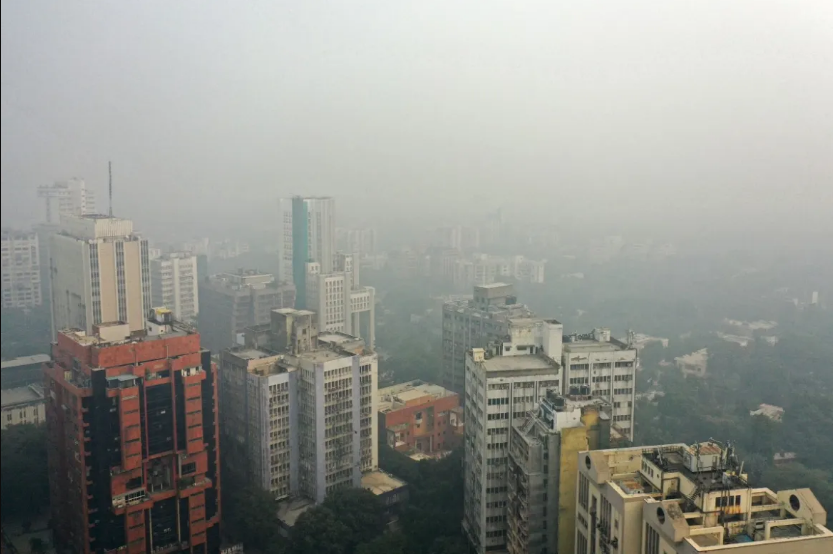
As winter approaches, New Delhi’s toxic smog once again forces residents to confront one of the most pressing environmental and public health crises in the world. The worsening air pollution in India’s capital has driven many families to make an unthinkable choice — leave their homes to protect their health.
Among those who have fled is Natasha Uppal, a 36-year-old maternal health advocate who left Delhi with her husband in 2022. The couple moved to Bengaluru, a decision inspired by their desire to raise a child in cleaner air. “When we thought about what kind of environment we could create for our child, the air became the biggest barrier,” Uppal told AFP. Days after relocating, she discovered she was pregnant — a moment that reaffirmed her decision.
Uppal, now the founder of Matrescence India, describes herself as a “pollution refugee.” While Bengaluru’s air quality sometimes exceeds World Health Organization (WHO) limits by up to three times, it remains far safer than Delhi’s, where PM2.5 levels — tiny, cancer-causing particles that penetrate the bloodstream — soar to 60 times higher than WHO standards during winter months.
Delhi’s air quality has deteriorated so severely that it consistently ranks among the world’s most polluted cities. Each year, the capital is blanketed in thick, acrid smog caused by crop burning, vehicle emissions, and industrial activity. Efforts like vehicle bans and water-spraying trucks have done little to combat the crisis. Authorities have now turned to cloud-seeding experiments as a potential short-term solution.
A study published in The Lancet Planetary Health estimated that between 2009 and 2019, 3.8 million deaths in India were linked to air pollution exposure. Health experts warn that polluted air significantly increases the risk of respiratory infections in children, leading many parents to seek refuge elsewhere.
For Vidushi Malhotra, a 36-year-old education consultant, the breaking point came when her young son fell ill repeatedly. In 2021, she moved her family to Goa, where she says her son can finally breathe freely. “When I visit Delhi now, I see my loved ones suffering — and it breaks my heart,” she shared.
However, not everyone can afford to leave. Residents like Roli Shrivastava remain in Delhi but live under constant anxiety. Her toddler suffers from severe coughs each winter, requiring nebulisers and inhalers. “Our doctor told us not to wait — just start nebulising when the coughing begins,” she said.
Despite its economic opportunities and cultural vibrancy, Delhi’s worsening air quality is prompting more families to consider relocation. As Uppal puts it, “Clean air is a basic human right — something everyone should be able to take for granted.”