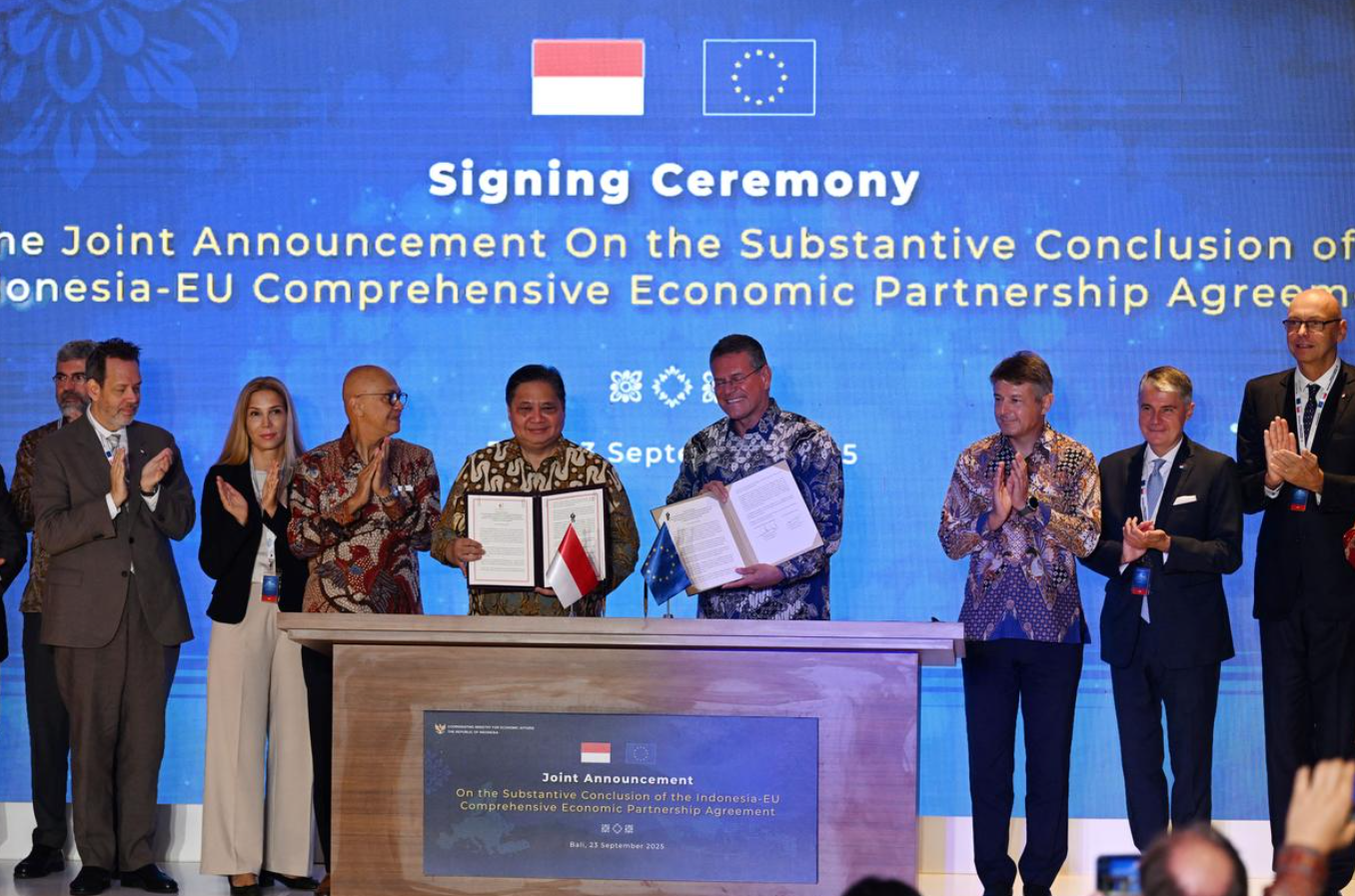
Indonesia and the European Union have officially concluded negotiations on a landmark trade deal after nearly ten years of discussions. The Indonesia-European Union Comprehensive Economic Partnership Agreement (CEPA) was signed in Bali by EU Trade Commissioner Maros Sefcovic and Indonesia’s Minister of Economic Affairs, Airlangga Hartarto.
This marks the EU’s third trade pact with Southeast Asian nations, following similar agreements with Singapore and Vietnam. The deal is set to open investment opportunities in key industries including electric vehicles, electronics, and pharmaceuticals, further strengthening bilateral economic cooperation.
Sefcovic emphasized that the CEPA sends a strong message about commitment to rules-based, open, and mutually beneficial trade. He noted that EU exporters will save approximately €600 million ($708 million) annually in duties, while European products will become more affordable for Indonesian consumers. EU President Ursula von der Leyen also hailed the agreement as a milestone for international trade relations.
Negotiations between Jakarta and Brussels began in 2016 but initially moved slowly due to disputes over palm oil and environmental concerns. Analysts say that global tariff wars and protectionist policies, particularly during the Trump administration, accelerated the urgency to finalize the pact.
The agreement also includes a protocol on palm oil, though details have not been disclosed. Airlangga Hartarto stressed that the CEPA provides stability against global uncertainties and demonstrates a joint commitment to fair and sustainable economic cooperation.
Around 80 percent of Indonesian exports to the EU, including palm oil, footwear, textiles, and fisheries, will become tariff-free once the deal is enforced. With the EU ranking as Indonesia’s fifth-largest trading partner and bilateral trade hitting $30.1 billion last year, the CEPA is expected to boost economic integration for both sides.
Despite optimism, environmental groups have raised concerns that the deal could increase deforestation due to rising demand for palm oil. Brussels had earlier introduced a deforestation regulation, but Indonesian officials say special considerations may be granted under the agreement.
The CEPA will now undergo legal checks, translation, and ratification by EU member states, the European Parliament, and Indonesia’s lawmakers. Full implementation is expected by 2027, making it a milestone in Indonesia-EU relations.