A dramatic scene unfolded in Australia’s Senate on Monday when far-right politician Pauline Hanson once again wore a burqa during a parliamentary session, triggering widespread condemnation from fellow lawmakers. The One Nation leader has long pushed for a nationwide ban on full face coverings, and her latest display reignited an already tense debate on Islamophobia and political provocation.
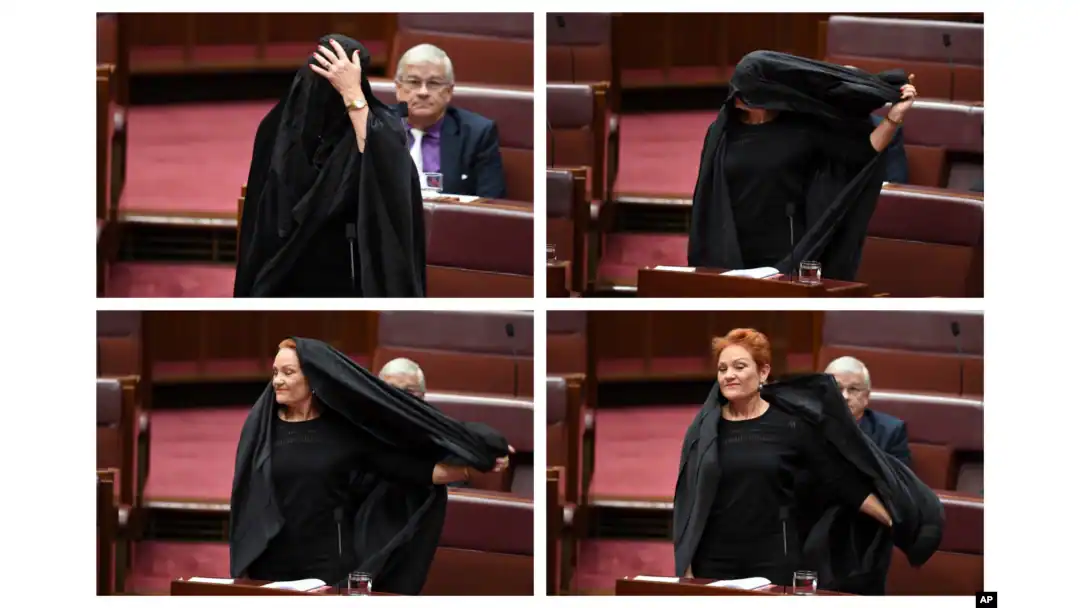
Hanson attempted to introduce a bill seeking a ban on full-face coverings, a policy she has promoted for decades. When other senators blocked her move, she returned moments later dressed in a black burqa and took her seat in the chamber. The act immediately drew sharp criticism across party lines, with many lawmakers calling it offensive and dangerous.
Australian Greens Senate leader Larissa Waters condemned the move as a deliberate insult, describing it as “the middle finger to people of faith.” She added that the stunt was not only disrespectful but also unsafe, given the rising concerns around Islamophobia in the country.
Foreign Minister Penny Wong also spoke firmly against Hanson’s actions, reminding the Senate of its responsibility to represent Australians of every background. Wong stressed that public office comes with the duty to show respect, saying lawmakers must “represent people of every faith” with decency and integrity.
Hanson refused to remove the garment despite repeated objections, forcing the Senate to suspend its proceedings. This is not the first time she has worn a burqa in parliament. In 2017, she entered the Senate chamber in a full black burqa to claim the garment posed a security risk and to link it to terrorism. That incident, too, had prompted backlash from security experts, civil rights groups and political leaders.
Her latest display comes at a time when her party, One Nation, is gaining traction. A recent poll cited by the Australian Financial Review reported the party holding a record 18 percent support, as the country’s conservative opposition continues to struggle with internal divisions.
The timing has amplified criticism that Hanson is using cultural and religious tensions to advance political capital. Her long-held stance that Islam is “incompatible” with Australian values has been widely discredited by scholars, community leaders and human rights groups.
In September, a government envoy acknowledged that Australia had failed to sufficiently address intensifying Islamophobia, a concern now echoed with greater urgency after Hanson’s latest parliamentary theatrics.
As the backlash grows, the incident has reopened national debate about the boundaries of political expression, respect for religious minorities and the responsibility of elected officials in a multicultural society.