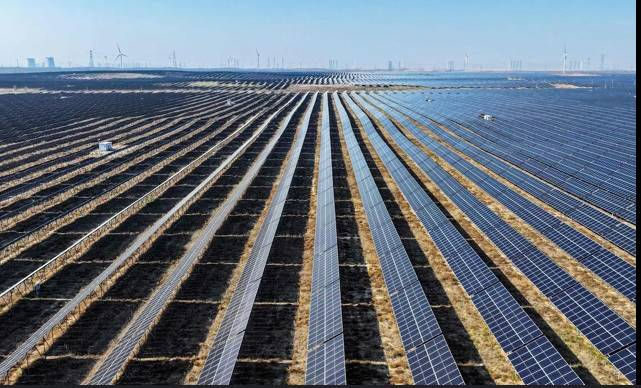
China’s carbon dioxide emissions held steady in the third quarter of 2025, thanks to a sharp rise in solar power generation and sustained growth in electric vehicle usage, according to a new analysis published Tuesday by climate research outlet Carbon Brief.
The report found that the world’s largest emitter has now seen emissions either flat or falling for 18 consecutive months, signaling potential progress in its long-term climate transition.
“After the first three quarters of the year, China’s CO₂ emissions in 2025 are now finely balanced between a small fall or rise, depending on what happens in the last quarter,” said Lauri Myllyvirta, lead analyst at the Centre for Research on Energy and Clean Air (CREA) and senior fellow at the Asia Society Policy Institute.
Myllyvirta noted that a decline in total emissions for the year has become more likely following a three percent year-on-year drop in September 2025.
Renewables drive the shift
The analysis, based on official Chinese government data, coincided with the opening of the UN’s COP30 climate conference in Brazil, where global leaders are debating accelerated efforts to meet emissions targets under the Paris Agreement.
Despite a surge in electricity demand, emissions from China’s power sector remained flat, largely due to record-breaking growth in renewable energy sources. Solar generation jumped 46 percent, while wind power expanded by 11 percent compared with the same quarter last year.
Meanwhile, emissions from transport fuels declined by five percent, reflecting lower consumption and the growing adoption of electric vehicles. Similar downward trends were observed in cement and steel production — traditionally two of the country’s most carbon-intensive industries.
However, the study also highlighted areas of concern. Oil-related emissions rose by 10 percent, driven by increased production of plastics and other petrochemical products.
Policy signals and symbolic milestones
In September, Beijing introduced its first-ever absolute targets for cutting greenhouse gas emissions — a major policy shift in its climate strategy. The plan commits China to reducing economy-wide emissions by seven to ten percent by 2035, relative to the country’s expected peak emission year of 2025.
While China had already pledged to peak its carbon output before 2030 and achieve carbon neutrality by 2060, this marks the first time the government has set concrete numerical reduction targets for the near term.
“Even a one percent fluctuation in China’s total emissions carries strong symbolic meaning,” Myllyvirta said, emphasizing that policymakers have intentionally left flexibility in determining when the country’s emissions peak will occur.
As solar and wind investments continue to accelerate, analysts suggest that 2025 could become a turning point year — where China’s emissions plateau begins to transition into a sustained decline.