32-year-old Wu Fei becomes China’s youngest space traveler
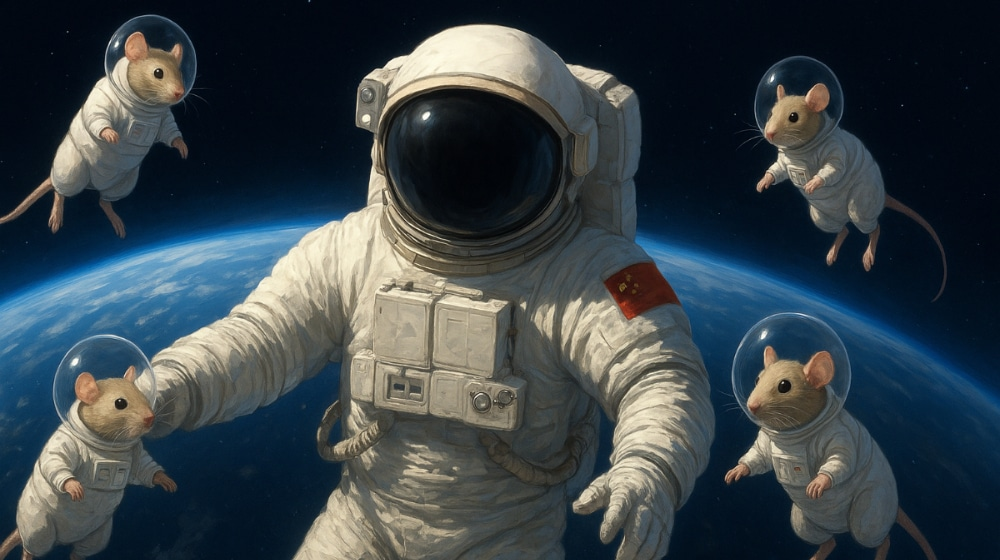
China launched its youngest astronaut, 32-year-old Wu Fei, along with two crewmates and four laboratory mice to the Tiangong space station early Saturday — marking another landmark in the nation’s rapidly advancing space ambitions.
The Shenzhou-21 spacecraft successfully docked with Tiangong at 3:22 am (1922 GMT Friday), barely three and a half hours after liftoff aboard a Long March-2F rocket from the Jiuquan Satellite Launch Centre in northwest China, according to state media.
Mission details
The six-month mission carries three astronauts — commander Zhang Lu, flight engineer Wu Fei, and payload specialist Zhang Hongzhang — who will conduct scientific experiments, maintenance work, and technology tests to support China’s long-term human spaceflight goals.
Before the launch, Wu Fei — now the youngest Chinese astronaut ever in orbit — said he felt “incomparably lucky” to represent his country in space.
“We will report back to our motherland and its people with complete success,”
commander Zhang Lu told reporters in a televised address before launch.
As the crew bid farewell to their families at the desert launch site, patriotic music echoed across the base — a symbol of Beijing’s growing pride in its space achievements.
China’s first rodent experiment in orbit
The four mice — two male and two female — aboard the spacecraft mark China’s first-ever in-orbit rodent experiment. The study will explore how microgravity affects biological systems, paving the way for deeper biomedical and space-life-science research.
The experiment underscores China’s ambition to establish itself as a global leader in space biology and medical science, complementing its progress in orbital construction and lunar exploration.
A milestone in China’s ‘space dream’
The Tiangong space station, completed in 2022, serves as the core of China’s manned space program and hosts new astronaut crews every six months.
Under President Xi Jinping’s “space dream” vision, China aims to:
- Send astronauts to the Moon by 2030, and
- Lay the groundwork for a permanent lunar base.
In recent years, China has achieved several major milestones:
- The Chang’e-4 probe landed on the far side of the Moon in 2019;
- The Tianwen-1 mission placed a rover on Mars in 2021;
- And the Tiangong station has now completed over 1,000 days of continuous human habitation.
Future cooperation and outreach
According to the China Manned Space Agency (CMSA), the Shenzhou-21 mission will include:
- Spacewalks and equipment upgrades,
- Anti-debris shield installations, and
- Preparatory tests for China’s upcoming Moon program.
The crew will also conduct educational sessions broadcast to classrooms across China, aiming to inspire the next generation of scientists and engineers.
While China remains excluded from the U.S.-led International Space Station due to a 2011 ban on NASA-China collaboration, Beijing continues to pursue international partnerships. In February 2025, China signed an agreement with Pakistan to recruit the first foreign “taikonauts”, expanding its diplomatic reach through joint space initiatives.